
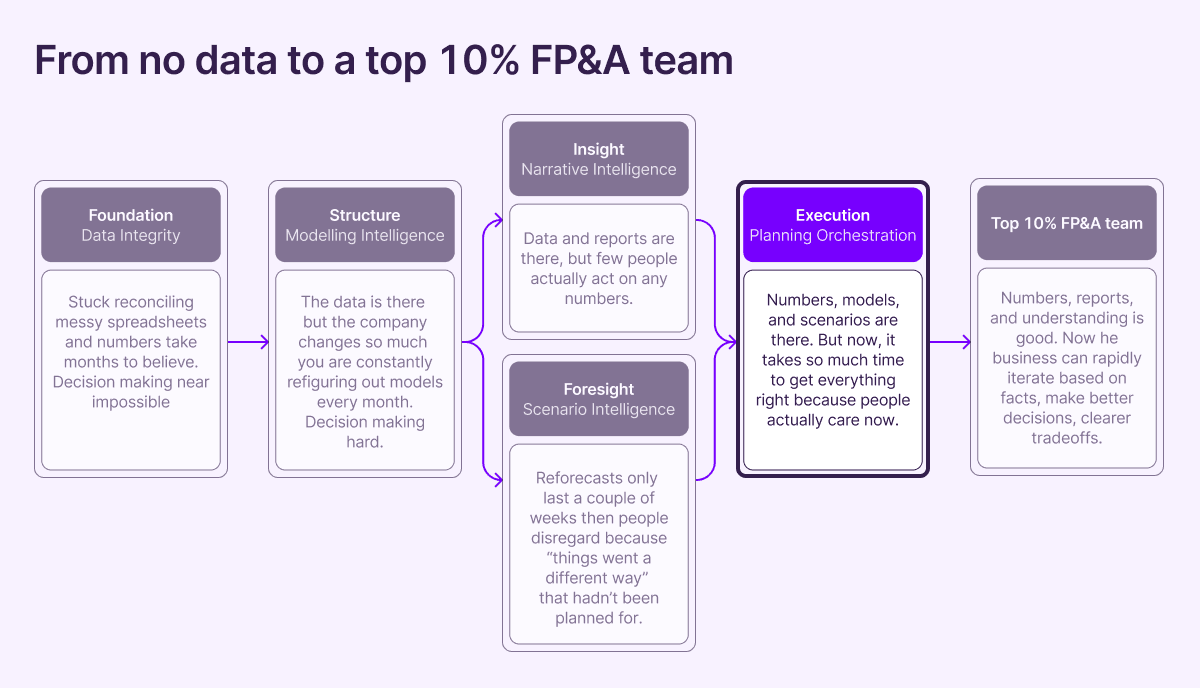
Now we were humming. From a fragmented, opaque list of transactions, we had built a machine that delivered drill-down reporting, actionable narratives, and dynamic scenario intelligence. The finance team was finally operating as a strategic partner. There was just one more dragon to slay: Automating the coordination.
Even over the yeras with all this improvement, climbing out of the five circles of data hell, our team still took time hunting down department heads, sending nagging emails, finding out someone hardcoded a cell and broke the roll-up, and spending Sunday nights consolidating 50 spreadsheets. Oh, and updating 50 different calendars and project plans to boot. It wasn't financial planning; it was cat-herding.
You can have the best data and the sleekest models in the world, but if the process of getting the company to plan together takes forever, you will constantly be working with old data or old strategy. Here is the fifth and final step in our series: taking the friction out of the planning process through Orchestration.
Let’s get to work.
1. Create a calendar and schedule
A chaotic process yields chaotic numbers. The last thing you want is a planning calendar hidden away in the depth of some excel file. You want your plans visible, you want people to run across them and find comfort in them. The best way to do this is to build a dashboard, put it on the front page of your intranet/slack/etc.
Ideally, you want to merge this with your operational calendar so that it is seen as ‘operations’ rather than an additional task on top of everything else. Make sure it is time-bound and expectations are crystal clear.
AI Quick Win: Feed your ideal board approval date to an LLM. Prompt: "Build a strict 6-week budgeting schedule with weekly milestones, specifically calling out chronological dependencies between HR, IT, and Department Heads." Then have it code into a wiki (claude code) anyone can edit.
AI Solution: Build the workflow directly into your FP&A tool. You map out the exact steps and assign owners, and the platform visually tracks the entire organization's progress against the master calendar in real-time.
2. Automatically email and run the process
Finance teams burn an incredible amount of political capital just reminding people to do their jobs. I used to spend hours every week drafting follow-up emails, trying to strike the perfect, exhausting balance between being a polite colleague and a demanding taskmaster.
Transitioning from personal, manual follow-ups to an automated cadence changes the dynamic entirely. When a system sends the reminder, it removes the interpersonal friction. It becomes a process requirement rather than a personal nagging from the finance team, preserving your relationships for actual strategic advisory.
AI Quick Win: Create a mail-merge prompt. Give an AI your list of late submitters and prompt: "Write short, polite, but firm follow-up emails to these five leaders, specifically referencing the exact template they are missing."
AI Solution: Set up automated orchestrations within your planning platform. The system nudges users via Slack or email based on their completion status, escalating to their manager automatically only when a deadline is breached.
3. Fact-check submissions and raise issues
Once the submissions finally rolled in, the real nightmare began. The Global Sales Team would submit a travel budget that was 400% higher than last year, or Engineering would forecast hiring 20 developers in a single month. Finding these anomalies manually meant tedious, line-by-line scrutiny of every single tab.
You have to shift the burden of justification back to the business owner before the numbers are even consolidated. If someone wants to double their software spend, they need to explain why at the exact moment they submit the number, rather than waiting for finance to catch it and interrogate them two weeks later.
AI Quick Win: Export the consolidated departmental submissions as a CSV. Upload it to an AI data analyst and run the prompt: "Compare these proposed budgets against our 12-month trailing actuals. Flag any single line item that deviates by more than 15%."
AI Solution: Embed anomaly detection at the point of entry. If a department head inputs a number that breaks historical trends, the platform instantly blocks the submission until they type a business case into an attached commentary box.
4. Follow-up with summaries and stress tests
When the master budget was finally assembled, the executive team inevitably wanted to poke holes in it. "What if sales come in 10% lower? Does this budget still hold up?" In the past, answering that question required tearing the whole consolidation down and rebuilding it over a weekend.
You have to anticipate these executive stress tests before the review meeting even happens. By proactively pre-running your newly consolidated numbers against macroeconomic shocks or lower conversion rates, you walk into the boardroom with answers rather than homework.
AI Quick Win: Feed the final rolled-up budget narrative to an LLM. Prompt: "Act as a skeptical Board Member. Read this budget summary and give me the top three areas of highest financial risk or aggressive assumptions."
AI Solution: Instantly toggle your new master budget against your worst-case macroeconomic scenarios within your unified platform. The AI generates a one-page summary showing exactly where the newly submitted plan breaks under pressure.
5. Gamify it a bit and reward people
Finance can feel like a thankless function, and budgeting often feels like an administrative punishment for the rest of the company. We realized early on that if we wanted compliance and accuracy, we had to make the process engaging and tap into the natural competitive instincts of our leadership team.
We started tracking which leaders forecasted most accurately and who submitted their numbers with the least friction. By publicizing this and rewarding the best planners, we turned a mundane corporate chore into a point of pride. When leaders care about the accuracy of their submissions, the quality of your entire financial foundation skyrockets.
AI Quick Win: Use AI to generate quick, personalized "Performance Summaries" for each leader post-budget. Prompt: "Write a fun, encouraging 3-sentence summary praising this leader for coming within 2% of their forecast."
AI Solution: Build a "Forecast Accuracy" leaderboard directly into your management dashboards. When leaders see their prediction accuracy ranked against their peers natively in the system, human competitive nature takes over organically.
In conclusion.
When you orchestrate planning correctly, it stops being a finance-only exercise and becomes a true company-wide rhythm.
This brings us to the end of our five-part journey. We’ve gone from an empty, messy database in Circle 1 of Data Hell all the way to a finely tuned, AI-orchestrated FP&A engine. The tools available today mean this transformation no longer takes seven years. With the right strategy, it takes months. Now, you have the data, you have the narrative, and you have the alignment. The only thing left to do is execute.