

The Bullets
|
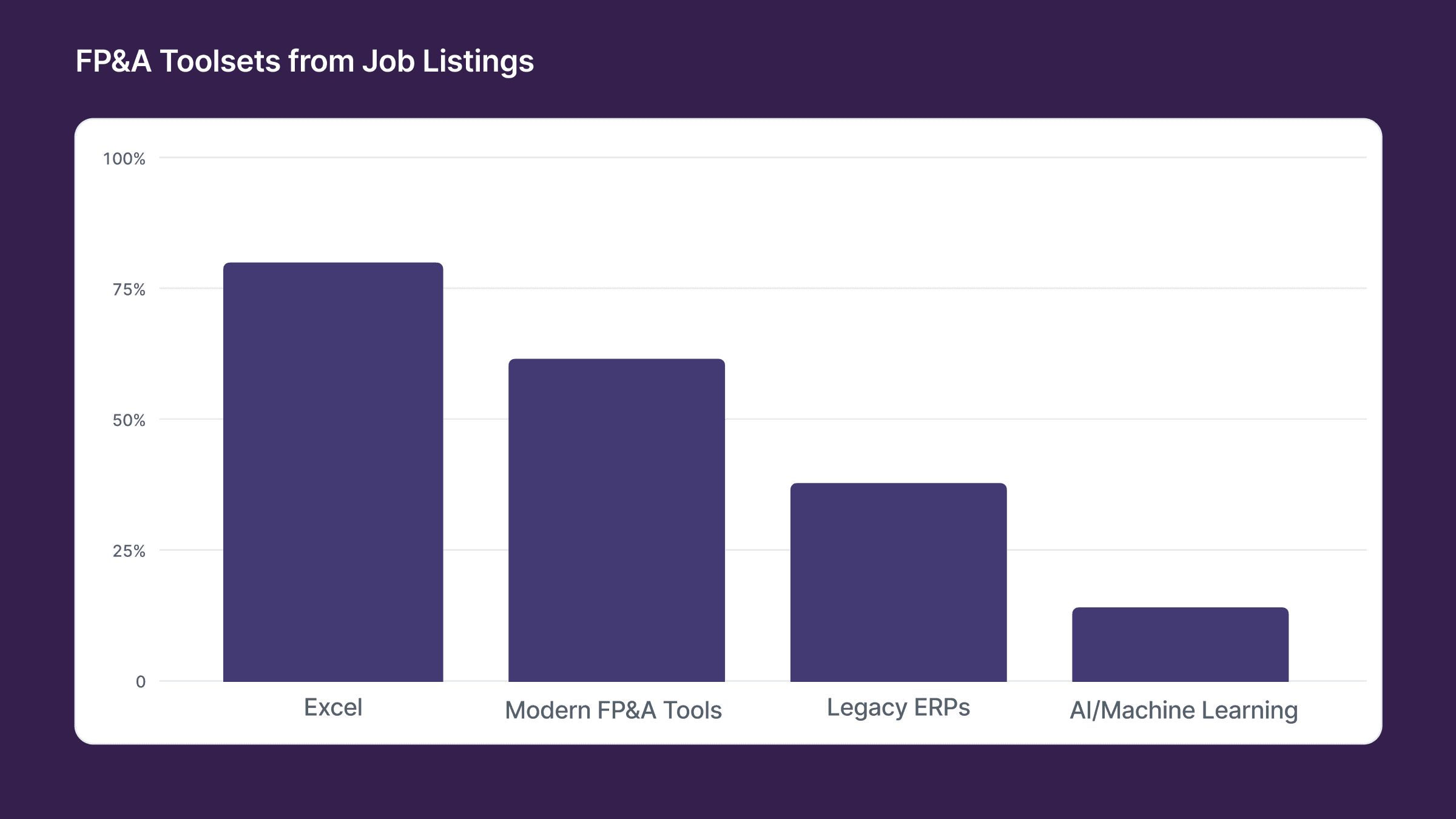
Change happens over time, until it is on you. And no, being able to use a spreadsheet is not going out of style anytime soon. But the tools you will be using in five years will be different from today. And of course, those tools will be essential:
“An investment in technology is an investment in your people. You’re freeing them from tedious tasks and empowering them to do more valuable work.” —Jack Carter, director at Openvale Group, or OVG
But today we are going to talk about the people that will be leading your finance improvements going forward. Now, I could jump back not even ten years ago, building custom ERPs out of Access or Excel or Google Sheets, but I will leave the old war stories for another time. First, let’s discuss what the modern FP&A team faces:
An explosion of data. It’s captured everywhere. Every tool comes with its own tracking data, every logistics point is now reporting in, dashboards now summarize dashboards…
New tools are scaling at an ever-increasing pace. “Smaller companies (1-500 companies) spend an average of $11.5M on SaaS and use 152 apps, while large enterprises (10,000+ employees) spend an average of $284M and use 660 apps.” According to Zylo’s benchmark
Business partners armed with AI. With early findings by Harvard/NBER showing: “Our findings reveal that AI significantly enhances performance: individuals with AI matched the performance of teams without AI, demonstrating that AI can effectively replicate certain benefits of human collaboration. Moreover, AI breaks down functional silos. Without AI, R&D professionals tended to suggest more technical solutions, while Commercial professionals leaned towards commercially-oriented proposals. Professionals using AI produced balanced solutions, regardless of their professional background.”
So, how can you find the right people that will lead this transition for years to come?
Don’t be afraid to train for non-manager roles
Let’s take two experiences. One, in tech, where I hired a ton of people who had “had the experience” in tech companies and hopped around every couple years. Or two, a multinational that hired a select few from various types of backgrounds. The first had a lot of turnover. In the second, the team I built has now led the company through four successful technology changes in five years, and every person is still there.
Why did the second work? Well… because a lot of skills are quite easy to train. We picked interested, smart people that were excited to solve problems (read: not institute ‘previous solutions’) If you are willing to put in some personalized training, you will be able to mold a flexible, diverse team that will continue to want to learn and grow. This enables you to:
Developing a mutually beneficial relationship: You get leverage and better outcomes, they get coaching and meaningful wins. Set clear problem statements, success criteria, and check-in cadence so both sides see progress.
Building loyalty: Investing time to frame problems and teach structure creates trust. People stay for leaders who help them grow, which cuts backfills and preserves momentum.
Retaining institutional knowledge: As people stick around, the institutional knowledge stays.
Increasing the pace of your technology adoption: They become strong implementers and stay curious about new tools, so upgrades stick and spread.
It also opens the door to a much wider pool of candidates, meaning you have a better selection when hiring someone who fits your company.
Tip: This doesn’t mean formal training programs. This means your relevant manager giving new employees well-defined problems, helping them structure the solution, and then, when solved, giving more open-ended problems so they can grow.
Build out your finance pipelines
One of the best FP&A directors I ever hired now has a PhD in linguistics. Numbers are numbers, and solving problems is solving problems. Even history majors know how to use R and Excel at this point. Unless you are tasked with technical accounting, most corporate finance is pretty straightforward. Revenue minus expenses equals income. At the same time, it can also be fulfilling strategic work. Take advantage of this by:
Hiring out of college: Bring in smart, coachable talent early. This is particularly an option as new college graduates (especially in Tech) are finding roles harder to find.
Build pipelines across countries: Tap into global talent pools where analytical skills and English proficiency are high.
Lean into remote work: With companies instituting back-to-work policy, there has been a true demand increase for fully remote work.
Rotating across functions: Move analysts between FP&A, operations finance, and commercial teams to develop broad business understanding.
An added benefit is that people do not arrive with rigid ways of doing things. So again, they are more open to new tools and change.
Tip: Be proactive. Do not just stick to job sites. Every college has teams of career counselors who are hungry to find roles for their best students.
Hire managers for where you want to be
Wait, did we not say just hire new people and train them? Yes, for entry to mid-level roles. If you are looking across all levels, and want to focus on making sure your teams will build out a strong future. Let’s go role by role:
Managers. If you aren’t promoting someone internally, hire someone who comes from a well-run company so they know how to manage people. You don’t want to be training first time managers and entry-level employees.
Directors. Directors should have relevant skill levels at the next level of scale, so they can backfill into your executive leadership teams. They should understand systems and strategy equally and be able to build frameworks that help the business scale.
Specialist roles. If you are hiring for a specialized role then hire one level higher than you expect. Examples include international consolidation, supply chain finance, or debt management. It’s better to bring in someone with the experience to lead and upskill others than to hire someone who will need guidance you can’t provide.
You want to hire for the future. This is a mix of newer team members and managers/directors who have experience at well-run firms.
Tip: A huge plus on a resume is someone who has moved up within a single company over many years. This often shows both ambition, loyalty, and expertise.
Hire people people
No matter what tool you use, the one thing you know about the long term is that there will still be business partners to work with (at least for a while). Business partners are getting more savvy and are expecting more. They can get answers, strategies, and plug their numbers into any off-the-shelf AI and get a very good level of financial advice. So you need to hire people who have the skills to manage this. That means looking for:
People people. They can build trust quickly, handle tough conversations, and keep stakeholders engaged even when the numbers are not great.
Curious. They ask why the numbers move, not just how. Curiosity drives better analysis and better business understanding.
De-confrontational. FP&A often sits in the middle of tension between targets, reality, and what AI says. You want people who can defuse that and keep discussions productive.
Collaborators. The best FP&A professionals do not work in silos. They make other departments better by helping them understand and own their numbers.
The direction of finance is to become even more integrated with the business as nearly every company claims to be increasing their data-based decision-making. This means more and more of a role for finance professionals that can explain numbers.
Tip: Technical skills can be taught; interpersonal skills take much longer. When in doubt, hire for communication, empathy, and problem-solving first.
In conclusion
Change will continue. More data, new tools, a leveling up of general finance literacy. Hire for curiosity. Build pipelines, not just job postings. And when you find good people, invest the time to train and grow them. The spreadsheets will change; the mindset you build will not.