
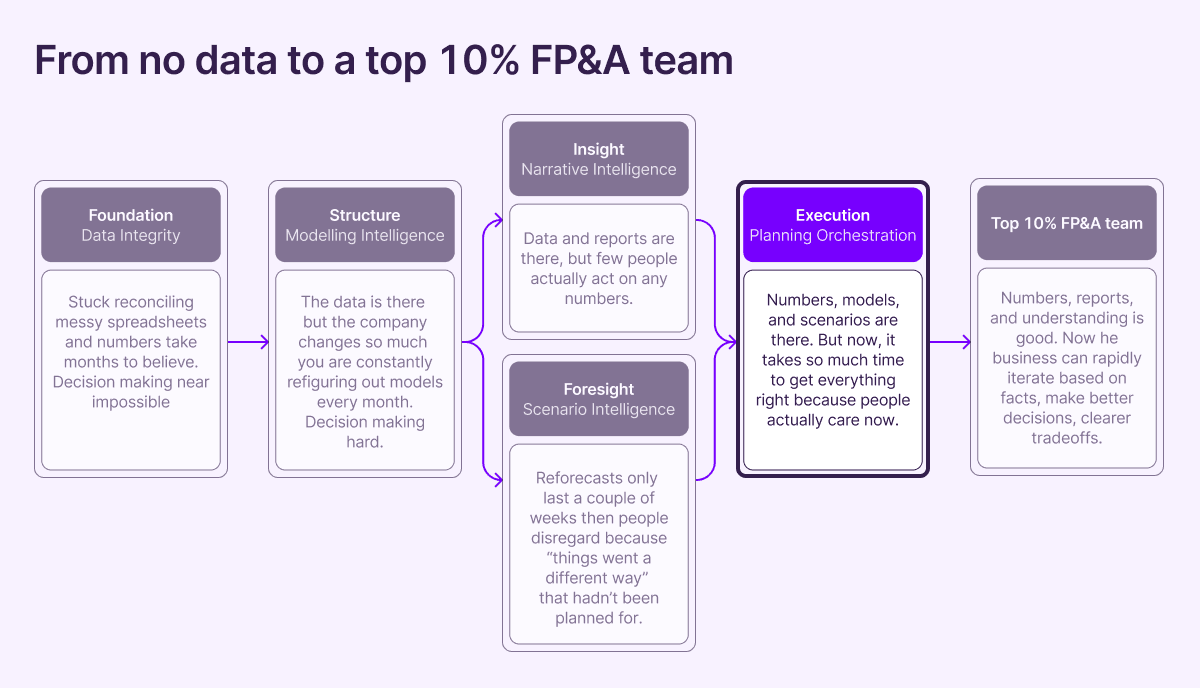
Three years into our finance transformation, we were finally humming. We had escaped data integrity hell, built resilient reporting, and learned how to contextualize numbers for the broader organization. The team was speaking the same language. Trust was high.
That’s when the next challenge emerged: predicting the future.
Once reporting stabilizes, finance teams hit a new wall. The question becomes how to model uncertainty without collapsing under a flood of what-ifs.
At that time, we were facing high-stakes decisions. We needed to fund a major geographic expansion while continuing to scale our core markets. That meant mapping possible futures, identifying the variables that actually mattered, and tying actions to outcomes leadership could stand behind.
At first, the story was clear. To fund the expansion, we had two options: cut all legacy programs by 10%, or shut down one expensive, underperforming program entirely.
Then the what-ifs started.
What if the underperforming program turned around?
What if revenue exceeded expectations?
What if we cut other programs by 20% instead?
What about a combination of all three?
We had built solid models, but not ones designed to withstand a flood of scenarios. Alignment quickly gave way to version chaos.
We eventually fixed it. But it took months.
With today’s tools, this should take weeks or less.
If this challenge sounds familiar, we’re unpacking it step by step in our AI webinar series on how finance teams move from stable reporting to confident scenario-driven decisions. You can register here to join the upcoming sessions.
Let’s get to work.
1. Backsolve target to set initial goals
We started by building our most complex model first. That was a mistake.
The models were detailed, slow to update, and consistently led us to the same conclusion. Detail became distraction.
We scrapped the approach and worked backwards from a future state five years out. That forced clarity. We defined the unit economics required to support that future, then mapped them back to the present. Only after that did we rebuild the model.
Backsolving cut through the noise immediately.
AI Quick Win: Export your baseline and state your target (year-end EBITDA in my case) and prompt: "Calculate the required month-over-month growth rates and cost-reduction percentages needed across the top five departments to bridge the gap."
AI Solution: Modern FP&A platforms feature native goal-seeking algorithms and scenario and sensitivity modeling charged with AI. Input your target metric, and the system automatically recalculates the required operational shifts across all linked departmental models to make that reality mathematically possible.
2. Identify the key variables and sensitivities
You need to be able to say “that doesn’t matter” when you are asked about 85% of what-if questions. Not all variables are equal. Backsolving helps, but really you need to run your variables through a Monte Carlo simulation to see which has the biggest impact over time (if you are a big enough company, that is). You might think you intuitively know your main drivers, but actually putting them on paper reveals their relative weight.
You need to identify the absolute core levers that actually move the needle and sensitize them relentlessly. By isolating these key variables, like customer acquisition cost, gross margin, or sales cycle length, you can be confident in what you need to hit.
AI Quick Win: Ask AI to rank your assumptions by their impact on cash flow and outcomes. Use it to challenge intuition and narrow the scenario space to the few variables that actually deserve stress-testing.
AI Solution: AI can monitor these critical variables continuously, detect drift early, and update downstream projections automatically. Scenario planning shifts from periodic exercises to ongoing sensitivity awareness.
3. Drill down to see impacts you wouldn’t see
The hardest part of scenario planning isn't modeling the primary action; it's catching the second-order effects. If we chose to expand into a new market, it was easy enough to predict the local impacts. But what we couldn’t see were the secondary impacts.
Expanding to a new region meant diverting funds, which meant we could sustain fewer global headcount in our legacy markets to hit the targets we wanted. It meant that team members there would be lost, no matter if they were contributing to how other teams worked. The trials we had going wouldn’t be applicable to other programs. Oftentimes, when you are deep in the numbers its easy to forget about these.
AI Quick Win: Use AI as a structured thinking partner to surface second-order impacts you are likely missing. Prompt it to think beyond the P&L and into operational, organizational, and systems consequences.
AI Solution: When AI has access to historical relationships across the business, it can anticipate downstream effects automatically. A change in one area triggers modeled impacts elsewhere, exposing tradeoffs that are hard to see in isolated scenarios.
4. Unify scenarios and escape version hell
When you model a Base Case, a Best Case, a Worst Case, and an "Expansion Case," the data gets incredibly messy fast. When scenarios exist in silos, the organization loses its single source of truth, and finance spends more time reconciling versions than analyzing the business.
To escape this, you have to treat financial models the way software engineers treat code. You need a centralized environment where you can spin up a "branch" of your main budget, tweak the variables to see what happens, and then merge the winning plan back into the master file without destroying the original data structure.
AI Quick Win: If you are stuck in spreadsheets, use an AI Code Interpreter. Upload two different Excel models and prompt: "Run a diff on these files. Output a clean table showing exactly which cells and formulas changed between Version A and Version B."
AI Solution: Adopt a unified planning environment with native branching capabilities. You can spin up unlimited what-if scenarios, and the platform’s AI will automatically generate a clean audit trail summarizing exactly what assumptions were changed and by whom.
In conclusion.
Scenarios are your financial radar. AI matters here not because it is faster, but because it changes how scenarios are created, maintained, and understood. When AI helps define targets, isolate real drivers, surface hidden impacts, and keep scenarios unified, finance stops reacting to questions and starts shaping choices.
If you want to see how modern finance teams are putting this into practice, we’re covering these exact patterns in our live AI webinar series. You can register here to join the next session and go deeper on how scenario intelligence actually works in the real world.
Next week, we tackle the final boss of the transformation: Planning Orchestration.
See you then.