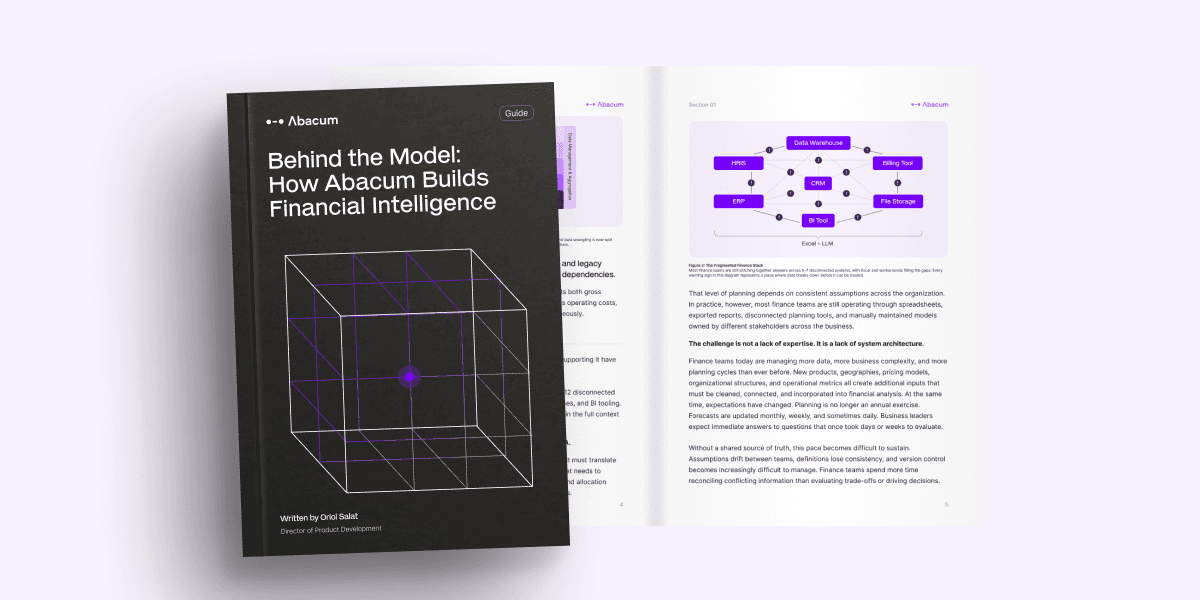

The short version: finance leaders are comfortable letting AI agents do the work and far less comfortable letting them decide. Abacum Intelligence is built for that split, because every output is traceable back to the data, formulas and assumptions behind it, which is what lets someone stand behind the number.
Ninety-five percent, then fourteen
Deloitte published its Finance Trends 2027 report earlier this month, based on responses from 1,434 finance leaders across 26 countries. The topline numbers are bullish. Ninety-five percent are comfortable with agentic workflows in at least some finance activities, and seventy-seven percent are comfortable letting agents move beyond recommendations into some degree of autonomy. Only fourteen percent support full autonomy for decisions.
Nobody in that survey is anti-AI. These are large companies with the budgets, teams, data infrastructure and governance to adopt this properly. The hesitation starts at a specific point: when AI moves from helping with the work to making a decision somebody has to defend.
Which suggests the debate about autonomy is slightly off. The more important issue is accountability.
The bottleneck is moving, not disappearing
The easy interpretation is a maturity curve. Models improve, trust grows, controls strengthen, and the fourteen percent eventually becomes forty. Maybe. But the same survey asked what is actually holding adoption back, and the answers point less at model quality than at confidence and control. Forty-one percent cited employee trust in AI outputs. Forty-two percent said their AI ambitions already exceed what they can currently execute.
An agent can draft a forecast, explain a variance or recommend a resource shift, and all of that is becoming dramatically cheaper. Someone still has to review the output, approve the number, understand how it was produced and stand behind it when the board starts asking questions. A plausible answer is not enough. The number has to hold when someone pulls on the thread.
What an agent has to show you before you sign
Provenance. If an agent explains why revenue missed, you need to know which ledger, period, entity, mapping and assumption it used. A polished explanation without lineage does not reduce the work. It creates another answer that somebody has to verify before it can be trusted.
Determinism, where determinism matters. Language models are probabilistic by design, which helps with synthesis, commentary and explanation, and is much less useful for arithmetic. Ask the same finance question twice and the underlying number should not move. Generated language can sit around the number without inventing it.
Uncertainty. The system should tell you what it could not reconcile, what was missing and where its confidence drops. An agent that quietly excludes an entity it could not map, or smooths over a gap in the data, is far more dangerous than one that says it does not know.
Why this changes the job
We spend a lot of time asking how much work an agent can do. The better question for a finance leader is how much of that work they can trust enough to act on. AI is not removing accountability from finance. If anything it is making accountability more important.
As analysis gets cheaper and answers become easier to generate, the value of finance shifts away from producing information and toward understanding which answer is right, what assumptions sit underneath it, and whether the business should act. That is a very different job.
How Abacum helps
Abacum Intelligence is built around that separation. Every output is traceable, so you can see exactly which data sources, formulas and assumptions drove a result and inspect the logic behind any cell instead of guessing at it. Answers are consistent and grounded in how your business actually works, which is the property that lets a number survive a second run. Approval workflows keep a person on the sign-off, and the underlying figures stay current from the systems your data already lives in. If you want the detail on how the model is constructed, we wrote that up in behind the model.
Add your team to the data
We are running our own research on how AI is changing the finance function, the State of the Modern Finance Function survey. It takes a few minutes and covers how your team works now, the tools you actually use, and what you are prioritizing next year.