
The short version: Abacum works with finance teams running annual planning. The average annual budget still takes 8.7 weeks, unchanged in three years, because most of the cycle is waiting rather than modelling. The median company produces five versions before it is done.
There is one number in AFP’s benchmarking survey I have trouble explaining away.
The average company takes 8.7 weeks to produce an annual budget. That is the same figure as three years ago. In between, FP&A technology spend hit record levels and roughly four in five teams put AI somewhere in the process.
I sell planning software for a living. This is not the number I would have picked.
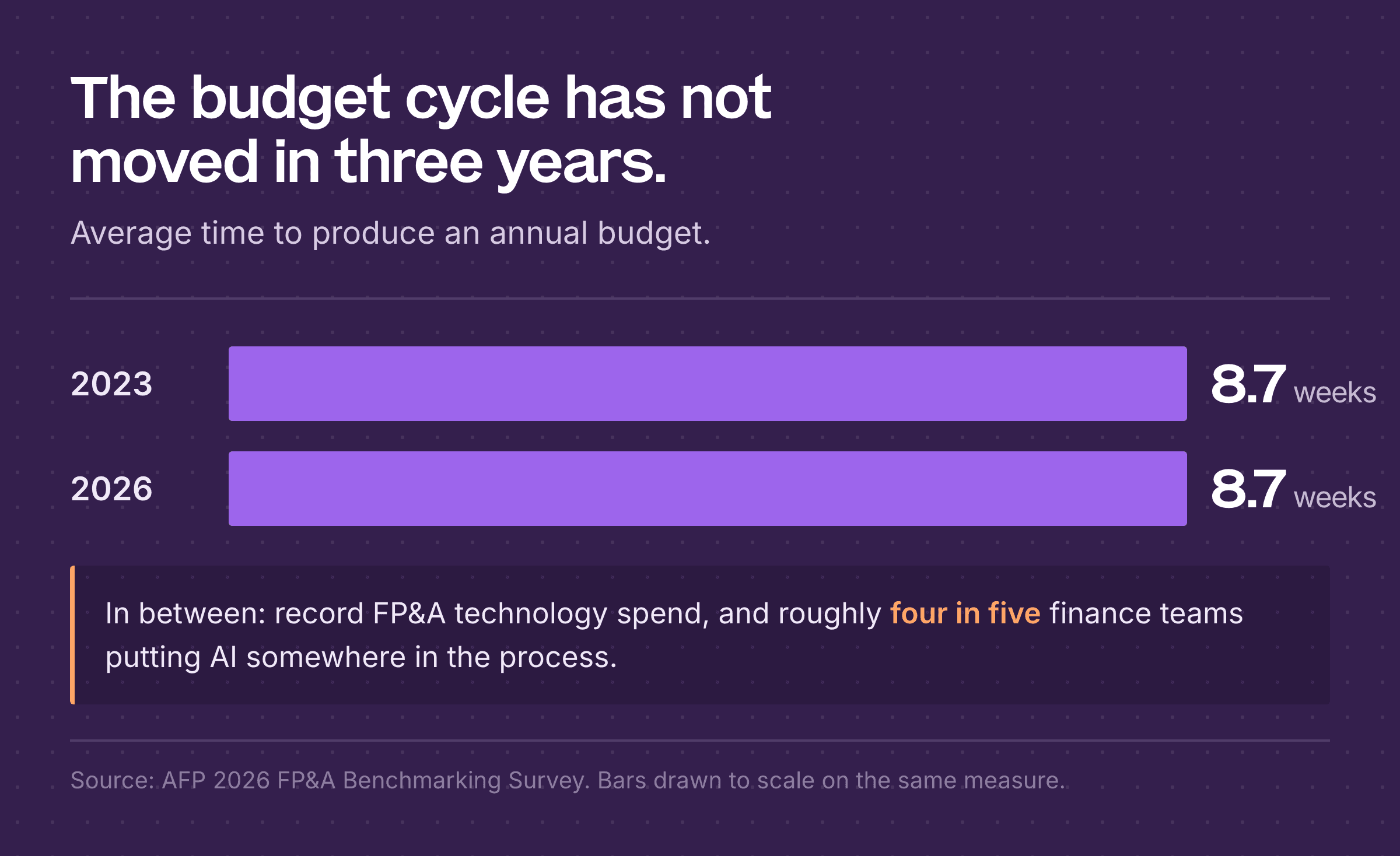
Average time to produce an annual budget. Bars drawn to scale on the same measure. Source: AFP 2026 FP&A Benchmarking Survey.
So either the software does not work, or it has been fixing something that was never the bottleneck.
APQC settles it. In their benchmarking, most of the budget cycle is not work at all. It is waiting for inputs or responses. The median company produces five versions of the budget before it is done. Five versions is the number worth staring at, because a faster model does not remove a single one of them.
The blank cell problem
Only 12% of teams publish their macro assumptions before submissions open.
Picture what that means on the ground. Templates land in a department head’s inbox. There is a cell asking for next year’s growth rate and nobody has told them what rate finance is using. So they guess, and they guess in the direction that protects their budget. Forty percent of teams report their first draft came back over-optimistic, which is the polite description of the same event.
Finance cuts it back. The department learns that submissions get cut, so next year they open higher. APQC calls this the car dealership dynamic, where both sides start at a number neither believes and then spend weeks walking to the middle. That is where your five versions come from, and not one of them is a modelling problem.
Nine weeks is a distance, not a speed
APQC has top performers finishing the annual budget in 25 days or less. At the 75th percentile it takes about 50. Same work, double the time, and the gap is mostly handoffs.
The most useful finding in their data is also the most counterintuitive. Top performers tend to start later. Waiting means you budget against actuals rather than against a forecast of actuals, so the first draft lands closer to real and there is less to argue about. Starting early feels responsible and buys you an extra round of fiction.
The AFP data points the same way. Teams who build their scenarios before the cycle opens, rather than in reaction to questions, finish in 8.1 weeks against 9.2 for everyone else, which AFP wrote up here. Four days is a small prize, and that is rather the point. Nothing moves this number much, because the number is set by how many times work changes hands.
Four decisions that cost nothing
Publish the assumption pack with the templates. Rates, headcount ceilings, macro inputs, the growth number you will defend to the board. Every input you leave blank is a guess you pay for in round two.
Say out loud that you will not haircut submissions. Then do not. The padding only stops once departments believe the first number is the real one, and that takes a cycle or two of proof.
Cap the versions at two, and say so at kickoff. If the median is five and you name no limit, you will get five. A first draft that might be the last one gets written more carefully.
Start a week later than feels comfortable. You will be working from more actuals and fewer assumptions, and you will spend less of December reconciling a plan built in October to a year that already moved. The mechanics of all four are in our guide to building budgets that drive business performance.
Where the software does help
I am not arguing against the tools. That would be a strange position for me, and it would also be wrong. Faster modelling is real and it matters a great deal once the coordination is sorted. What no platform will do on your behalf is decide who submits what, in which order, against which assumptions, and whether their first number will be taken seriously. Those are calendar and trust decisions, and they are free. I went through the process mechanics in Planning Orchestration.
If FY27 lands at nine weeks again, do not start with the model. Count the versions.